Key Takeaways:
- Choosing an experienced surgeon matters more than the technology or technique used; it’s the deciding factor in safe, natural-looking results.
- Success depends on personalised planning, not just which surgical technique is chosen.
- Hairline design, graft placement, and donor area preservation all shape the outcome.
- FUE and FUT are both effective; the right choice depends on individual hair loss pattern and donor availability, not one being universally superior.
- Long-term results depend on realistic expectations, proper recovery, and ongoing hair care after the procedure.
With so many clinics and treatment options available today, identifying the best hair transplant doctor in Mumbai can feel genuinely difficult. Cost & convenience often influence the decision, but surgical outcome depends on considerably more than the procedure alone; it depends on the surgeon’s grasp of donor-area physiology, graft survival rates, and hairline aesthetics specific to the patient’s facial structure.
Hair restoration is not a purely mechanical process. It requires surgical precision in graft extraction and placement, combined with aesthetic judgment in designing a hairline that complements bone structure, forehead proportion, and existing hair density. Choosing the right hair transplant surgeon in Mumbai, India involves assessing several clinical factors: their experience with different transplant techniques (FUE, FUT, or a combination), their approach to pre-surgical diagnosis & donor-area assessment, and their protocol for long-term follow-up care.
This guide covers what to look for in a certified hair transplant surgeon, the clinical and technical factors that determine natural-looking results, and the specific questions patients should raise during consultation before committing to treatment.
Why Choosing the Right Hair Transplant Surgeon Matters
Outcome in hair transplantation is not determined by graft count alone. Clinical judgment plays a considerably larger role, specifically, the surgeon’s assessment of hair loss progression, preservation of donor area density, and hairline design that maintains a natural appearance as the patient ages.
Patient anatomy varies considerably: facial structure, hair calibre, and donor site density all differ from one individual to the next. A qualified surgeon accounts for these variables during pre-operative planning, aiming for natural-looking results while retaining sufficient donor reserve for subsequent procedures if clinically indicated.
What Qualities Should You Look for in the Best Hair Transplant Doctor?
Finding the right hair transplant doctor in Mumbai takes more than looking at before-and-after photos or comparing prices across clinics. What actually determines the outcome is the surgeon’s training, hands-on experience, surgical technique, and whether they build a plan around the individual’s specific pattern of hair loss rather than a generic template.
Experience and Specialised Training
Hair transplantation is a specialised discipline; it demands real expertise in restoration technique, donor area management, and aesthetic planning. A surgeon who has focused specifically on this field tends to handle varying patterns of hair loss and the different needs each patient brings considerably better.
Expertise in Modern Hair Transplant Techniques
The surgeon should be well-versed in current techniques, including FUE and FUT. Knowing the strengths and limitations of each is what lets them recommend the right approach for a given case, instead of running every patient through the same procedure regardless of fit.
Natural Hairline Design
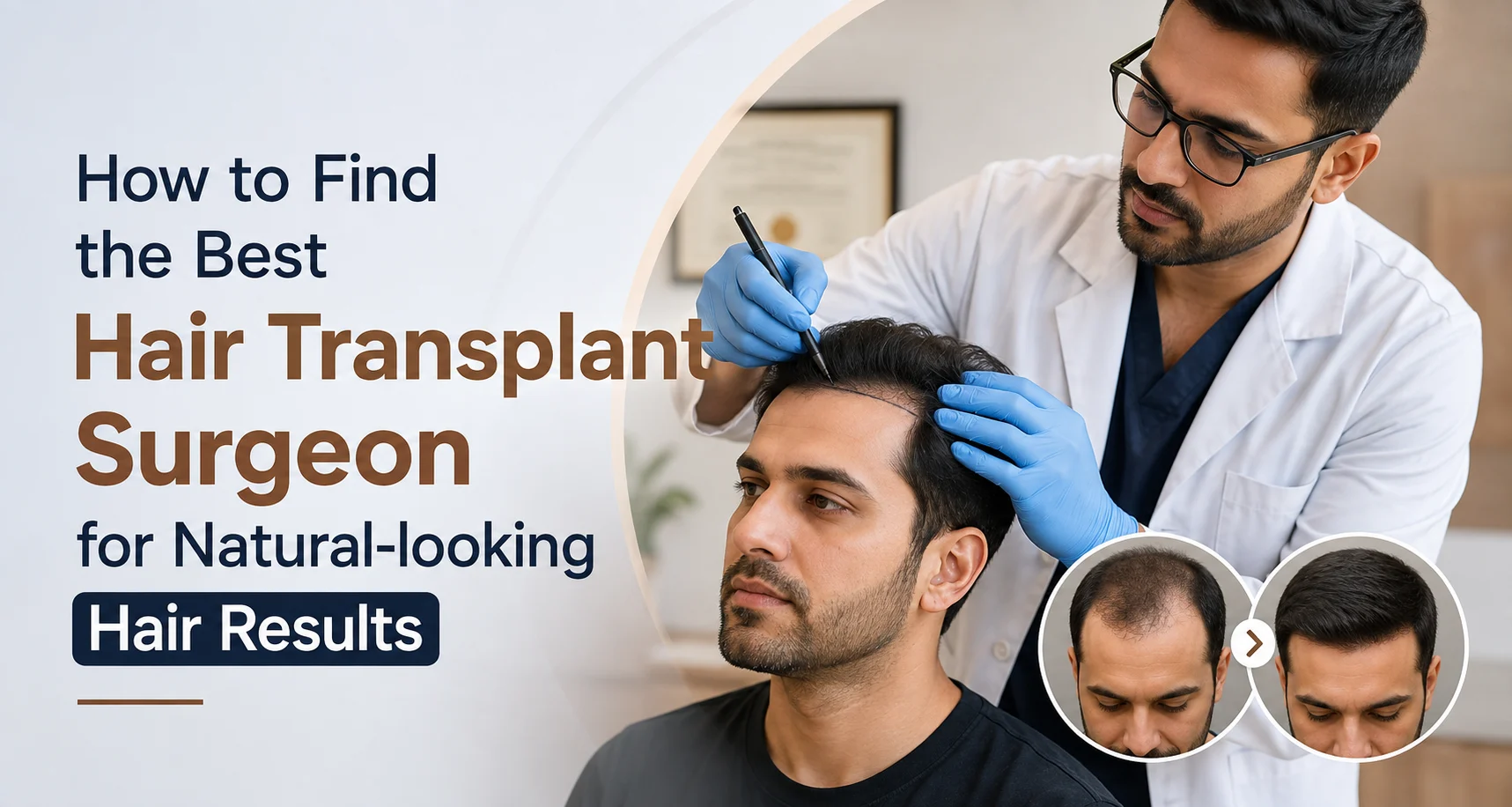
Getting a natural result starts with the hairline itself. Facial proportions, age, hair texture, and how the hair loss is likely to progress all need to factor into a hairline that still looks right years down the line, not just immediately after the procedure.
Personalised Consultation
A proper consultation covers the pattern of hair loss, scalp condition, donor hair availability, medical history, and what the patient is actually hoping to achieve. This is what allows the surgeon to confirm whether someone’s a good candidate and shape a plan around their specific case.
What Makes a Natural-Looking Hair Transplant?
A natural-looking result comes down to meticulous planning, precise surgical technique, and a solid grasp of facial aesthetics. Rather than focusing purely on how many grafts get placed, an experienced surgeon weighs several factors that shape both the immediate appearance and how well the result holds up over time.
Hairline Design
The hairline needs to complement the patient’s facial proportions, age, and pattern of hair loss. A well-planned hairline looks natural right after it grows in, and continues to look right as the patient ages further.
Correct Graft Placement
Each follicular unit is placed strategically to recreate how hair naturally distributes across the scalp. Getting the spacing and placement right is what leads to uniform growth and a seamless, undetectable appearance.
Proper Hair Direction and Angle
Hair doesn’t grow at a single uniform angle; it varies across different parts of the scalp. Matching this direction and angle in the transplanted grafts is essential for the result to blend in with the surrounding, existing hair.
Balanced Hair Density
Natural-looking density comes from careful distribution, not from packing the maximum number of grafts into one area. The goal is even, balanced coverage, while still keeping enough donor hair in reserve for the future.
Preserving the Donor Area
The donor area is a limited resource, not an unlimited one. Careful harvesting technique helps maintain how it looks while making sure enough healthy follicles remain available if further restoration is ever needed down the line.
Questions to Ask Before Choosing a Hair Transplant Surgeon
Asking the right questions helps establish the surgeon’s expertise, evaluate the proposed treatment plan, and support a well-informed decision.
- How many hair transplant procedures has the surgeon personally performed?
- Which technique, FUE, FUT, or a combination, best suits my specific condition?
- Who will actually perform the graft extraction and implantation, the surgeon or a technician?
- Can I see before-and-after photographs of cases similar to mine?
- What results can I realistically expect, given my hair loss pattern?
- What does the recovery timeline typically look like?
FUE vs FUT Hair Transplant: Which Technique Is Right for You?
FUE and FUT are both established techniques, and choosing between them isn’t about one being better than the other in general. It comes down to the specifics of the case, the pattern of hair loss, how much donor hair is available, what the patient wants out of treatment, and what the surgeon determines through clinical assessment.
FUE Hair Transplant
With FUE, individual follicular units are extracted straight from the donor area and implanted where hair loss has occurred. Patients often lean toward this option to avoid a linear scar, get through recovery faster, and keep the option of wearing their hair short.
FUT Hair Transplant
FUT works differently. A thin strip of scalp is removed from the donor area, and follicular units are carefully separated from it before transplantation. This tends to come up when a larger number of grafts is needed, or when getting the most out of the donor area in one sitting matters most.
Which Procedure Offers Better Results?
Neither one wins outright. Done well, both FUE and FUT can produce results that look genuinely natural. What actually decides which is right comes down to the individual, their hair type, the state of their donor area, how far the hair loss has progressed, and the plan being followed over the long run.
Common Mistakes to Avoid When Choosing a Hair Transplant Clinic
- Picking a clinic based on price alone
- Trusting marketing claims that sound too good to be true
- Not checking the surgeon’s actual credentials
- Skipping a look at previous patients’ results
- Rushing through, or skipping, the consultation
What Happens During a Hair Transplant Consultation?
During this appointment, the surgeon evaluates the hair loss pattern, talks through expectations, and puts together a treatment plan built around the patient’s current condition and long-term restoration goals. This typically covers:
- Medical history review
- Hair loss evaluation
- Donor area examination
- Scalp assessment
- Hairline planning
- Discussion of suitable treatment options
- Expected recovery timeline
- Long-term maintenance plan
Hair Transplant Recovery: What to Expect After Surgery
Recovery from a hair transplant is gradual, with visible changes unfolding over several months. Healing timelines differ from person to person, but understanding each stage generally helps set expectations that are actually realistic.
First Week
Mild swelling, redness, and scab formation around the transplanted grafts are common at this stage. Following the surgeon’s post-operative instructions matters most here, since the grafts are still vulnerable during this initial healing window.
First Month
The transplanted follicles begin settling into the scalp, and most patients can gradually get back to their normal routine. The treated area continues healing quietly in the background as this happens.
Hair Shedding Phase
Temporary shedding of the transplanted hairs usually shows up within the first few weeks. This can look alarming, but it’s a normal part of the hair growth cycle, not a sign the procedure hasn’t worked.
Three to Six Months
New hair starts to emerge as the transplanted follicles move into the active growth phase. Density and coverage improve steadily from here, becoming more noticeable with each passing month.
Final Results After 9–12 Months
Most patients see their final results settle in somewhere between 9 and 12 months, though the exact timeline still depends on individual healing and growth patterns.
Are You a Suitable Candidate for Hair Transplant Surgery?
Hair transplant surgery is not suitable for everyone experiencing hair loss. A thorough evaluation by an experienced surgeon helps determine whether the procedure is appropriate, based on the cause of hair loss and donor hair availability.
You may be suitable if you:
- Have male pattern hair loss, or a suitable type of female hair thinning.
- Have sufficient healthy donor hair for transplantation.
- Are in good general health and fit for surgery.
- Have a relatively stable pattern of hair loss.
- Have realistic expectations about the procedure and its outcomes.
Conclusion
Choosing the right hair transplant surgeon is one of the most consequential decisions in the restoration process. FUE and FUT have both advanced significantly as techniques, but outcome quality depends on far more than the procedure itself. Patient evaluation, hairline design, donor area preservation, graft placement, and long-term planning all factor into whether the result actually looks natural.
Hair loss presents differently in every patient, which is precisely why treatment needs to be individualised rather than standardised. An experienced surgeon assesses the pattern of hair loss, sets realistic expectations, & recommends an approach suited to the patient’s current condition & future needs. Choosing a qualified surgeon & going through a proper consultation before committing to treatment is what ultimately supports a result that looks natural.
FAQs
How do I choose the best hair transplant doctor in Mumbai?
Compare surgeons based on their specialised training, years of hands-on experience in hair restoration, a genuine portfolio of past results, and whether they build the treatment plan around your specific case. A detailed consultation before deciding is non-negotiable.
What qualifications should a hair transplant surgeon have?
A recognised medical degree with surgical training, documented experience performing hair restoration procedures, and specific proficiency in techniques like FUE and FUT, not just general cosmetic surgery experience.
What makes a hair transplant look natural?
Five things working together: a hairline designed to suit your face and age, precise graft placement, hair angled to match your natural growth direction, density that looks balanced rather than overly dense in one spot, and a donor area that’s been carefully preserved.
Is FUE better than FUT?
No single technique wins across the board. FUE tends to suit patients seeking minimal scarring and shorter hairstyles; FUT tends to suit patients needing a higher graft count in a single session. The right choice depends on your specific hair loss pattern and donor availability, decided by your surgeon.
How many grafts will I need?
This depends on how much area needs coverage, how advanced the hair loss is, your natural hair characteristics, and the density you’re aiming for. Your surgeon calculates this specifically for you during consultation, it isn’t a standard number.
Are hair transplant results permanent?
The transplanted follicles themselves generally are, they’re resistant to the hormones that cause pattern baldness. But your original, non-transplanted hair can still thin over time, so some patients pair the transplant with ongoing medical treatment to protect that hair too.
How long does recovery take?
You can typically return to daily routines within a few days. Visible growth takes longer, building gradually over several months, with the final result usually visible between 9 and 12 months post-surgery.
Can women undergo hair transplant surgery?
Yes, women with certain hair loss patterns (not all types) can be candidates, provided they have enough donor hair and are confirmed suitable through a clinical evaluation first.