Key Takeaways:
- Significant weight loss can leave the skin with varying degrees of laxity or excess tissue.
- Skin tightening treatments can improve firmness and mild to moderate skin laxity.
- Ultherapy, laser, and radiofrequency treatments work through different mechanisms and may suit different skin concerns.
- Non-surgical treatments cannot remove substantial amounts of excess skin.
- Surgical body contouring may be considered when there are significant folds or excess skin.
- Treatment should be selected based on the degree of laxity, treatment area, skin quality and individual needs.
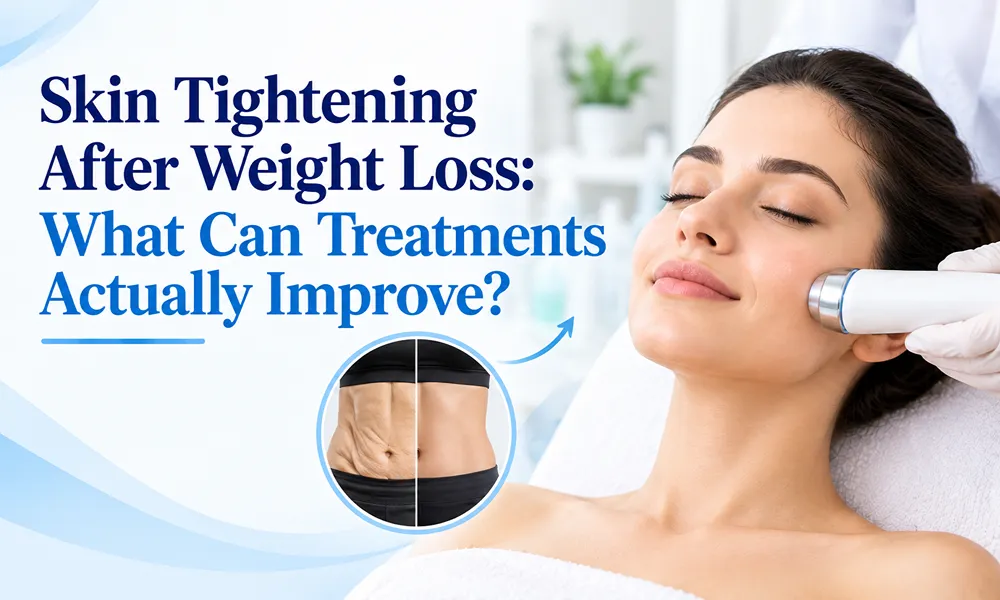
Weight loss does not affect body size alone. Skin that has been stretched over a prolonged period relies on collagen and elastin fibres to contract once the underlying volume decreases, though these fibres do not always do so fully. The result can be reduced firmness, mild laxity, or, in more pronounced cases, folds of excess skin.
The extent of sagging varies considerably between individuals. Age, genetics, the amount and speed of weight loss, existing skin elasticity, and the specific area affected can all influence the outcome. Skin tightening treatments can improve firmness and address mild to moderate laxity, but they have clear limitations; they cannot remove substantial excess skin. The appropriate approach ultimately depends on how much laxity is present and the quality of the skin in the affected area.
Why Does Skin Become Loose After Weight Loss?
Significant weight loss reduces the volume beneath the skin, but the skin itself doesn’t always contract at the same rate. When skin has been stretched for a prolonged period, changes within the collagen and elastin network can reduce its ability to fully retract. Age, genetics, how much weight was gained and for how long, the extent of eventual weight loss, and overall skin quality can all influence the degree of laxity that results.
It’s also worth distinguishing between mild to moderate sagging, which may respond well to skin tightening treatments, and substantial folds of excess skin, where non-surgical tightening tends to have limited effect and surgical assessment becomes the more appropriate route.
What Can Skin Tightening Treatments Actually Improve?
Skin tightening treatments are primarily designed to improve skin laxity and firmness rather than remove excess tissue. Depending on the technology used and the condition of the skin, they may help with mild to moderate sagging, improve the appearance of early laxity, and support collagen remodelling, which can gradually improve skin texture and firmness.
They have limitations, particularly when there is a substantial amount of loose or hanging skin after major weight loss. In such cases, energy-based treatments cannot physically remove the excess tissue in the way surgical body-contouring procedures can. The degree and location of laxity therefore need to be assessed before deciding whether skin tightening is appropriate.
Skin Tightening Treatments After Weight Loss
Different energy-based treatments work at different depths beneath the skin, and each suits a different degree of laxity. Which option actually fits depends on the treatment area, skin quality, and how much tightening is genuinely needed.
Ultherapy Skin Tightening
Ultherapy delivers focused ultrasound energy that provides controlled thermal stimulation beneath the skin’s surface. This can trigger collagen remodelling and gradually improve firmness in selected areas with mild to moderate laxity. It’s a non-surgical approach, and it does not remove excess skin.
Laser Skin Tightening
Laser skin tightening uses controlled laser energy to heat targeted skin layers and stimulate collagen remodelling from within. Different laser technologies work at different depths, so the right option comes down to the area being treated, skin type, and how much laxity is actually present.
Other Skin Tightening Options
Radiofrequency-based treatments use controlled heat to stimulate collagen within the skin and may suit selected cases of laxity. Several other energy-based technologies exist too, though their suitability ultimately depends on the individual’s skin condition and treatment goals.
What Is the Best Skin Tightening Treatment After Weight Loss?
No single treatment fits every case here; the right choice genuinely depends on how much laxity is present, where on the body it’s located, the quality of the skin itself, and whether the concern is mild sagging or something closer to real excess skin. Ultherapy, laser, and radiofrequency all suit selected cases of mild to moderate laxity, but they’re not built to handle substantial excess skin. That’s typically where a surgical assessment becomes the more realistic path forward, rather than skin tightening alone.
When Is Surgery Considered?
Surgical body-contouring becomes relevant when weight loss leaves behind significant folds or excess skin that non-surgical tightening simply can’t address adequately. Procedures such as abdominoplasty, arm lift, or thigh lift actually remove excess skin, reshaping the affected area far more directly than energy-based treatments ever could. Whether surgery is the right call depends on how much excess skin is present and where, overall health, weight stability, and what the individual actually wants to achieve.
Skin Tightening Treatment in Mumbai, India
If you are considering skin tightening after weight loss, the first step is to assess how much laxity is present and whether the skin has mild sagging or more significant excess tissue. Dr Debraj Shome offers skin tightening treatments in Mumbai, including non-surgical options such as Ultherapy, with the approach selected according to the individual’s skin condition and concerns.
TEC, with clinics in Mumbai and branches across India, also offers skin tightening procedures and other treatments for skin laxity. A consultation can help determine whether a non-surgical treatment is suitable or whether surgical body contouring may be more appropriate when there is substantial excess skin.
Conclusion
Skin laxity after weight loss looks different from one person to the next. Some people have mild sagging that responds genuinely well to treatments aimed at stimulating collagen and rebuilding firmness. What decides which category someone falls into usually comes down to a mix of things: how much weight actually came off, skin elasticity to begin with, age, and which part of the body took the hit.
Knowing the difference between “loose skin” and genuine excess skin matters more than people realise when it comes to choosing treatment. Ultherapy, laser, and radiofrequency-based options can work well for mild to moderate laxity, but when the skin’s genuinely excessive, surgical body contouring tends to be the only thing that actually delivers. Dr. Debraj Shome offers skin tightening treatments including Ultherapy, with the approach selected according to the individual’s skin condition, concerns, and treatment goals.
FAQs
Can skin tightening help sagging skin after weight loss?
Yes. Skin tightening treatments can improve mild to moderate sagging by stimulating collagen remodelling and enhancing skin firmness. They are considerably less effective, however, when substantial excess skin is present.
What is the best skin tightening treatment after weight loss?
There is no single treatment that suits every individual. Ultherapy, laser, and radiofrequency-based treatments may each be considered, depending on the degree of laxity, the treatment area, skin quality, and individual requirements.
Does Ultherapy tighten loose skin?
Ultherapy uses focused ultrasound energy to stimulate collagen remodelling beneath the skin’s surface. It can improve firmness and mild to moderate laxity, though it cannot remove significant excess skin.
How much is one session of Ultherapy?
The cost of a single Ultherapy session varies according to the treatment area, extent of laxity, and the number of lines or energy levels required. A consultation is necessary to determine an appropriate treatment plan and accurate cost.
Does laser skin tightening work after weight loss?
Laser skin tightening can improve firmness and mild laxity by stimulating collagen remodelling. Its suitability depends on factors including the treatment area, skin type, and the degree of loose skin present.
Can skin tightening remove excess skin?
No. Non-surgical skin tightening can improve firmness and laxity, but it cannot physically remove substantial excess skin. In such cases, surgical body-contouring procedures may be required instead.
How long do skin tightening results take?
Results vary depending on the treatment used and individual skin response. Since collagen remodelling occurs gradually, improvements in firmness typically develop over the following weeks and months rather than appearing immediately.