Key Takeaways:
- Liposuction removes stubborn fat deposits from specific areas to improve body shape, rather than achieve significant weight loss.
- The amount safely removed varies with the treatment area, body composition, and overall health.
- Removing more fat does not mean better results; safe removal and balanced contours are the priorities.
- Liposuction is best suited to people near their target weight with localised fat that persists despite diet and exercise.
- Swelling gradually settles, with final results usually becoming clearer within three to six months.
- Maintaining a stable weight helps preserve the results, as remaining fat cells can still expand.
Liposuction is a surgical body-contouring procedure that removes localised deposits of subcutaneous fat. The safe volume differs between patients. A surgeon sets it after examining the treatment area, body composition, skin elasticity, and overall health.
During consultations, patients often ask how much fat can be removed in one session and whether they will see significant weight loss afterwards. Those questions have separate answers. Liposuction surgery corrects disproportion caused by stubborn fat deposits. Reducing overall body weight is not its purpose.
How Much Fat Can Be Removed with Liposuction?
No universal figure exists. A patient with a small deposit on the inner thighs needs a very different plan from someone undergoing multi-area contouring of the abdomen, flanks and back.
Liposuction acts on subcutaneous fat, the layer between the skin and the underlying muscle. Most surgeons first infiltrate the area with tumescent fluid, a dilute solution of saline, local anaesthetic and adrenaline. This fluid limits bleeding and eases fat extraction. The surgeon then introduces a thin cannula through small incisions to break up and aspirate the fat.
Planning revolves around total aspirate volume, meaning the combined fat and fluid the surgeon withdraws. The American Society of Plastic Surgeons classifies removal above 5 litres as large-volume liposuction. At that level, fluid shifts become more pronounced, and patients usually need closer post-operative monitoring.
A good outcome comes from balanced body contouring, not maximum fat removal. Overly aggressive aspiration increases surgical risk and frequently leaves dents or surface irregularities.
How Much Weight Can Be Removed with Liposuction?
Fat weighs less than people expect for its volume. So even after a visible change in shape, the scale may move only modestly.
The procedure redefines specific regions instead of lowering total body mass. In the first few weeks, tumescent fluid and post-operative swelling can even push the reading up temporarily.
Liposuction therefore offers no treatment for obesity and no substitute for diet, exercise, or medical weight management. Surgeons typically select patients who sit close to their target weight yet retain diet-resistant fat in particular zones.
Factors That Affect Liposuction Fat Removal
Every plan reflects a mix of anatomical findings and medical considerations.
Treatment Area and Fat Distribution
The abdomen, flanks, thighs, hips, arms, and back account for most procedures. Each region holds fat differently. The abdomen often tolerates larger volumes, while the inner thighs and arms call for a more conservative approach to keep the contour smooth.
Skin Elasticity and Body Composition
Elastic skin retracts over the newly contoured area. Lax skin, often seen after pregnancy or major weight loss, may sag once the fat beneath it disappears. The surgeon also checks the muscle layer, since abdominal muscle separation can limit what liposuction alone achieves.
Overall Health and Surgical Safety
Diabetes, smoking, clotting disorders and poor circulation all affect wound healing and anaesthetic risk. The number of areas, the expected aspirate volume and the operating time also feed into the decision. Longer procedures raise the risk of fluid imbalance and blood clots.
What Results Can You Expect After Liposuction?
Patients see some change immediately, but swelling, bruising and fluid retention mask the true outcome at first. Most surgeons advise compression garments for several weeks to control swelling and support skin retraction.
The contour sharpens gradually. Much of the swelling settles within six to eight weeks, while the final result often takes three to six months to appear. Volume removed, skin quality, surgical technique, and individual healing all shape that end point.
In adults, the fat-cell count stays largely fixed, so extracted cells do not return in the same way. The cells left behind can still expand with weight gain, though. A stable weight protects the result.
Is Liposuction the Right Option for Everyone?
The best candidates have localised fat, a weight near their goal, and a clear understanding of what surgery can and cannot change.
Patients who want substantial weight loss, or who have marked skin laxity, often gain less from liposuction. For small, well-defined deposits such as submental fat, clinicians may suggest Kybella non-surgical lipolysis instead. That option works through a chemical breakdown of fat cells and differs from surgery in both scope and outcome.
A clinical assessment shows which approach suits the patient’s anatomy and concerns.
Consultation with Dr. Debraj Shome
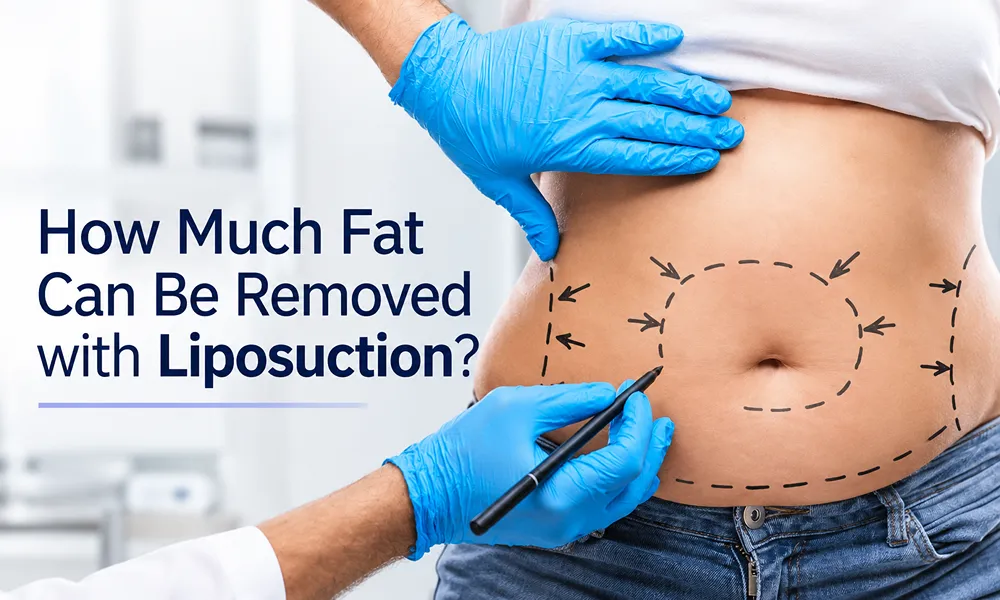
Dr. Debraj Shome assesses body composition, treatment goals, and suitability for liposuction at the first visit. He maps the treatment areas and decides on a fat-removal volume that fits the patient’s frame. He also reviews skin elasticity and medical history, and explains the expected recovery timeline before finalising the plan.
Conclusion
The amount of fat removed through liposuction depends on the treatment area, body composition, skin quality, and overall health. The surgeon plans each case around total aspirate volume and treats removal above roughly 5 litres as large-volume liposuction that needs closer monitoring.
The procedure reshapes diet-resistant fat; it does not reduce weight. The final contour emerges over three to six months, and a stable weight keeps it intact. A personalised surgical plan puts patient safety and proportion ahead of maximum fat removal. It also matches each patient to the right approach, whether that is liposuction alone, a combined procedure or a non-surgical option.
FAQs About Liposuction
How much fat can be removed with liposuction in one session?
It varies with the patient’s health, the treatment areas, and the surgical plan. The surgeon works from total aspirate volume, fat plus fluid, and generally treats anything above 5 litres as large-volume liposuction that needs closer monitoring.
How much weight can be removed with liposuction?
Usually only a few kilograms at most. Liposuction targets shape and proportion rather than overall weight reduction.
Does removing more fat mean better liposuction results?
No. Over-aspiration raises surgical risk and often creates dents or uneven contours. Measured, balanced removal gives a more natural finish.
Is liposuction suitable for people who want to lose weight?
Liposuction is not a weight-loss procedure. It suits individuals near their target weight who have localised, diet-resistant fat deposits.
Can fat return after liposuction?
The extracted fat cells do not regenerate in the same way. The remaining cells can still enlarge with weight gain, so maintaining a stable weight preserves the outcome.
Can liposuction be combined with other cosmetic procedures?
Yes, in selected patients. Surgeons sometimes pair it with procedures such as abdominoplasty, depending on overall health, total operating time and safety considerations.
What should I expect during liposuction recovery?
Swelling, bruising and tenderness are normal in the early weeks. The surgeon may advise compression garments and will give instructions for wound care and a phased return to work and exercise.